

Multi-sample energy metabolism analysis system
Key words:
Classification:
- Product Description
-

Oroboros O2k is a multi-sample energy metabolism measurement/analysis product that is currently highly recognized internationally.
The O2k system uses high-resolution polarographic oxygen electrodes and full-featured fluorescence technology to accurately quantify and analyze the mitochondrial respiratory function of samples and the energy metabolism of organisms.
Multifunctional parameter detection: can simultaneously detect oxygen consumption rate, respiratory rate, respiratory control ratio, pH value, mitochondrial membrane potential, free radicals, ROS, ATP, Ca2+, NO, H2S, TPP+.
Applicable to a variety of samples: It can be used to directly measure mitochondria, primary cells, cultured cells, tissues and organs, or microorganisms, plant cells, etc.
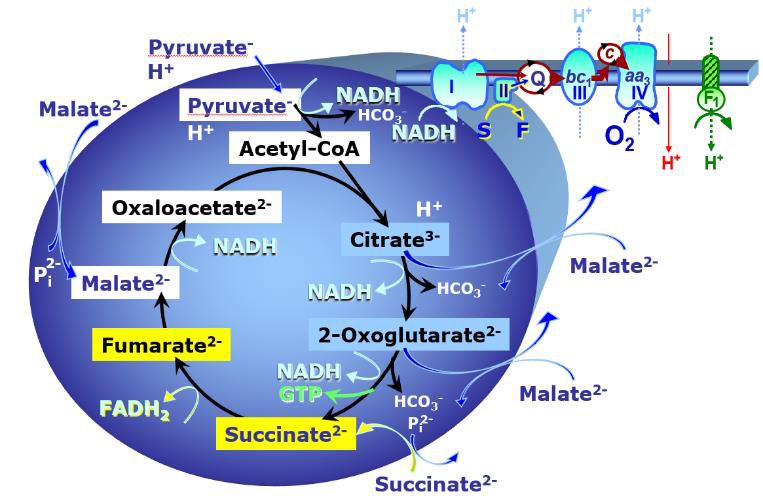
Performance characteristics:
❖ Dual channel system / multi-channel system
❖ Measurement sample volume 0.5ml-3.5ml
❖ Temperature range: 4-47 ℃, temperature stability is 0.002℃, low temperature test can be carried out
❖ Magnetic stirring function with variable speed
❖ Polarographic oxygen electrode sensor, the oxygen flow rate resolution is 1 pmol O2∙s-1∙ml-1, and the change within 5 minutes under stable conditions does not exceed 0.5 pmol ∙ s-1∙ml-1
❖ Fluorescence detection unit: dual channel/four channel
❖ Fluorescence detection parameters include: mitochondrial membrane potential Δψ, ATP, Ca2+, ROS
❖ Independent external electrode unit: PH, H2O2, TPP+, H2S, NO
❖ The sample chamber is made of extremely low-activity materials such as Duran glass and titanium to reduce background oxygen interference
❖ Synchronously display the concentration of flowing oxygen; automatically calibrate the oxygen signal.
❖ Dual-channel micro-injection pump, with injection and withdrawal functions, automatic control, can be programmed by software to perform precise timing and quantitative addition, without limiting the number of additions.
❖ Equipped with a manual dosing system and 15 different ranges of micro dosing needles
❖ Special tissue homogenization tools use homogenization tube technology to grind samples, and the sample quantity required is as little as a few milligrams.
❖ Experiments can be designed freely. Different substrates, inhibitors and other compounds can be added in real time to change mitochondrial respiration according to the experimental design. Up to 20 kinds of
❖ Powerful DatLab software functions: can display and record all measurement parameters in real time; can change the experimental design at any time during the experiment; can automatically calibrate parameters such as oxygen; has Protocol programming function, supports customers to customize Protocol programs, and is convenient for customers to choose.Oroboros O2K Technology Advantages
The high-precision electrode detection method uses open reagents in the experiment and does not consume experimental consumables. It is a closed detection environment and can carry out hypoxic/normoxic/hyperoxic experiments. It has a heating/cooling module that can realize electronic temperature control and high temperature accuracy. Accurate quantitative detection method. Directly detect the O2 content of the sample. The detection chamber has a stirring system to ensure that the sample solution in the chamber is uniform, which can improve the accuracy of the detection sample and the repeatability of the experiment.
Application demo:
The purpose of the experiment was to explore the effect of different concentrations of decoupling agent FCCP on the maximum oxygen consumption rate of cells, OCR. After cells were treated with the oxidative phosphorylation inhibitor oligozyme, the oxygen consumption rate of cells was significantly reduced, allowing cellular respiration to reach Leak levels. Start adding 0.5uM FCCP at the 30th minute of the experiment, and gradually increase 0.5uM every 120 seconds.
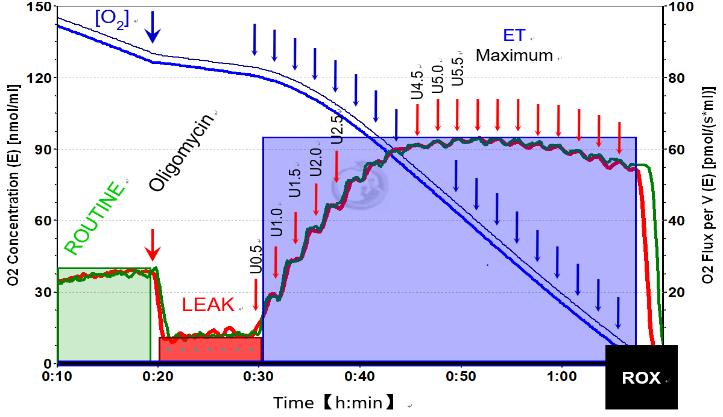
Experimental data results show that as the concentration of FCCP continues to increase, the oxygen consumption of cells increases significantly, and reaches the maximum value when the FCCP concentration is added at a dose of 5.5uM. Increasing the concentration will not cause a significant decrease in the cell oxygen consumption rate. There is a significant increase, which indicates that the optimal concentration of FCCP is 5.5uM.
Application demo:
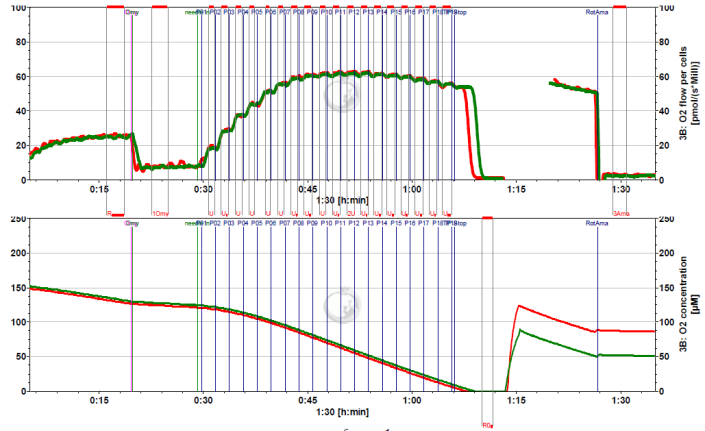
The purpose of the experiment is to understand the energy metabolism mechanism of cells. The experimental samples are different amounts of human vastus lateralis muscle tissue. Sample A3.4mgWw tissue and sample B2.8mgWw tissue were placed in a dual-channel cell metabolism measurement and analysis system, and malic acid, octanoylcarnitine, ADP, Glutamic acid, succinic acid, rotenone, malonic acid, myxothiazole, and antimycin were used to observe the oxygen consumption of cells. The red curve is sample A, and the green curve is sample B. The experimental data shows that the oxygen consumption rate of different amounts of samples after adding the same dose of drugs is basically the same.

Application demo:
The cells measured were mouse bone marrow cancer cells. The TIP 2k micro titration pump was used to add the uncoupler FCCP. The experiment set the titration interval to 120 seconds, 15 cycles of titration, and each time the amount was increased by 0.5uM. The dosing concentration ranged from 0.5uM to 7.5uM. The oxygen consumption rate varied with the concentration of the uncoupler FCCP; the O2 content gradually decreased.
Application Demo:
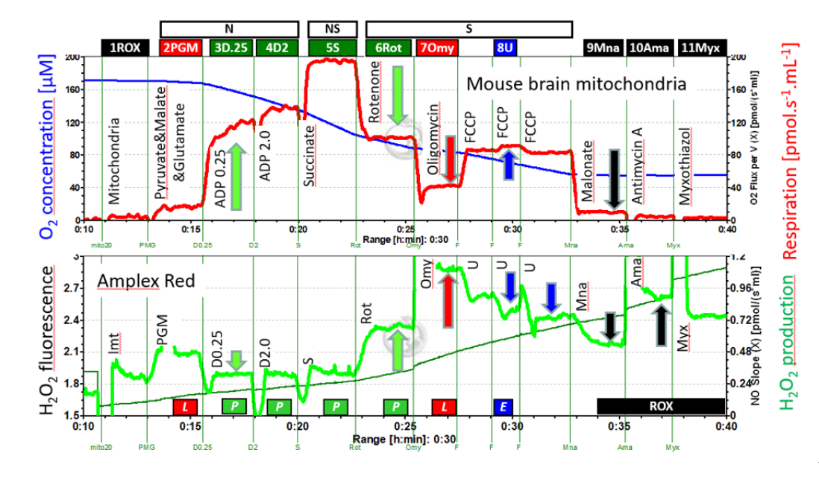
The experiment was to measure the interaction between the oxygen consumption rate of rat brain mitochondria and H2O2. Pyruvate, glutamate, ADP, succinate, rotenone, oligomycin, FCCP, antimycin, etc. were added in the experiment. The experimental results showed that the oxygen consumption rate of mitochondria changed with the addition of substrates during the addition of substrate-type reagents, while the change of reactive oxygen was not obvious. After the inhibitor was added, it was obvious that reactive oxygen accumulated, which in turn affected the change of aerobic rate.
References:
❖ Bajzikova M, Kovarova J, Coelho AR, Boukalova S, et al. Reactivation of dihydroorotate dehydrogenase-driven pyrimidine biosynthesis restores tumor growth of respiration-deficient cancer cells. Cell Metab 29:399-416.
❖ Rodríguez-Nuevo A, Díaz-Ramos A, Noguera E, et al. Mitochondrial DNA and TLR9 drive muscle inflammation upon Opa1 deficiency. EMBO J 37.
❖ Bhaskaran S, Pharaoh G, Ranjit R,et al. Loss of mitochondrial protease ClpP protects mice from diet-induced obesity and insulin resistance. EMBO Rep 19. pii: e45009.
❖ Mills EL, Ryan DG, Prag HA, Dikovskaya D, et al. Itaconate is an anti-inflammatory metabolite that activates Nrf2 via alkylation of KEAP1. Nature 556:113-7.
❖ Calcutt NA, Smith DR, Frizzi K, Sabbir MG, et al. Selective antagonism of muscarinic receptors is neuroprotective in peripheral neuropathy. J Clin Invest 127:608-22.


Product inquiry
Looking forward to your message !


